By Novatia Consulting · Market Research · Published 28 October 2026 · 9 min read
Most Nigerian businesses believe they know how their customers feel. The evidence they rely on is usually a complaints inbox, a few WhatsApp messages and the instincts of the sales team. All three over-represent the customers who are angry enough to speak up, and say nothing about the larger group who quietly stop buying.
A properly run customer satisfaction survey closes that gap. This guide explains how to design and run one in Nigeria: which metrics to use, how to choose a method that reaches your customers, what to ask, what to avoid, and how to turn the findings into decisions. It draws on the research and advisory work Novatia Consulting carries out for organisations across Nigeria and Africa.
Key takeaways
- Use CSAT, NPS and CES together. Each answers a different question.
- Match the survey method to how your customers actually reach you. Online-only surveys miss large parts of the Nigerian market.
- Ask what drives satisfaction, not only how satisfied customers are.
- Survey data is personal data under the Nigeria Data Protection Act 2023.
- A survey only pays off if someone owns the follow-up actions.
What a customer satisfaction survey is, and what it is not
A customer satisfaction survey is a structured set of questions put to a representative group of customers to measure how well your product or service meets their expectations, and to find out why. The second half of that definition is the one most companies skip.
A survey is not a suggestion box, a star rating on a delivery app or a feedback form at the end of a call. Those are useful signals, but they are self-selected. The people who respond tend to be at the extremes, so the picture they give is skewed. A survey built on a proper sample gives you results you can generalise to your whole customer base, with a known margin of error.
Why Customer Satisfaction Surveys matter more in Nigeria than most managers assume
Three features of the Nigerian market raise the stakes.
Customers switch easily. In banking and fintech, telecoms, retail, food, transport and logistics, a customer who has a poor experience can move to a competitor within days. Switching costs are low and alternatives are plentiful.
Reputation travels fast. Recommendations spread through family networks, WhatsApp groups and social platforms. A satisfied customer base is a marketing asset. A dissatisfied one is a liability that no advertising budget fully offsets.
Service conditions are uneven. Power supply, network reliability, traffic, payment downtime and last-mile delivery vary by location and time. Internal reports rarely capture how those conditions feel from the customer’s side.
The three core metrics of Customer Satisfaction Surveys: CSAT, NPS and CES
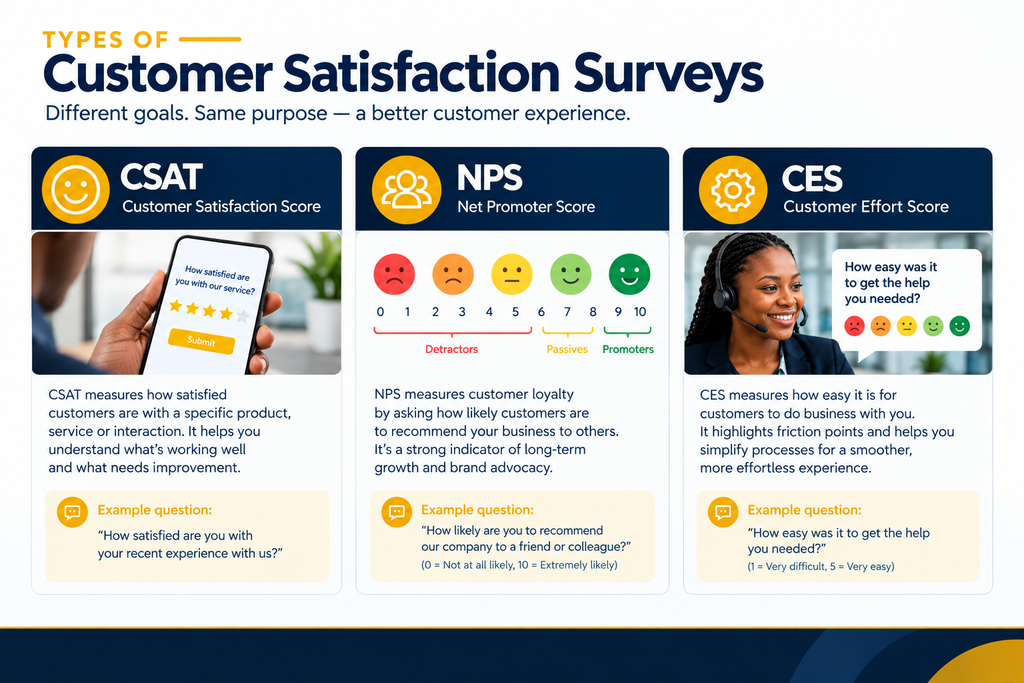
No single number describes customer experience. These three, used together, give a fuller picture.
| Metric | The question it answers | Typical question wording |
|---|---|---|
| CSAT Customer Satisfaction Score | How satisfied was the customer with this product or interaction? | “How satisfied are you with your experience today?” (1 = very dissatisfied, 5 = very satisfied) |
| NPS Net Promoter Score | How likely is the customer to recommend us? | “How likely are you to recommend us to a friend or colleague?” (0 to 10) |
| CES Customer Effort Score | How easy was it to get what they needed? | “The company made it easy for me to resolve my issue.” (1 = strongly disagree, 7 = strongly agree) |
How CSAT is calculated
CSAT is usually reported as the percentage of respondents who choose the top two options on a five-point scale. If 320 of 400 respondents answer 4 or 5, CSAT is 80%.
How NPS is calculated
Respondents who score 9 or 10 are promoters, 7 or 8 are passives and 0 to 6 are detractors. NPS is the percentage of promoters minus the percentage of detractors. If 200 customers respond and 90 are promoters (45%), 70 are passives and 40 are detractors (20%), the NPS is 25.
Why CES deserves attention
Customers often forgive a problem that was resolved easily, and leave over one that took five calls to fix. CES finds the friction in onboarding, payments, complaints handling and support, which satisfaction scores alone tend to hide.
A score tells you where you stand. The drivers behind the score tell you what to do about it.
Go beyond the score: driver analysis
Scores report outcomes. Management decisions need causes. A good survey includes rated questions on the specific attributes of your service, such as speed, staff courtesy, product quality, pricing, complaint handling, app reliability and branch environment. Statistical driver analysis then shows which of these attributes move overall satisfaction and loyalty the most.
This frequently overturns assumptions. Customers may say price is their main concern, while the data shows that reliability and resolution speed predict who stays. Without driver analysis, a business can spend heavily on the wrong fix.
How to conduct a customer satisfaction survey in Nigeria
1. Start with the decision, not the questionnaire
Write down what you will do differently depending on the result. Reduce churn? Redesign a branch network? Benchmark against a competitor? Evaluate a new product? The objective determines the sample, the method and the questions.
2. Define who you are surveying
Segment by what matters commercially: customer value, region, tenure, product line or channel. Decide which segments you need to read separately, because each one needs an adequate sample of its own.
3. Choose a method that reaches your customers
- Online and mobile surveys suit digitally active customers and are fast and economical.
- WhatsApp and SMS work well for short, post-transaction questionnaires.
- Telephone interviews (CATI) suit banking, insurance, telecoms and B2B accounts where phone contact exists.
- Face-to-face interviews (CAPI) reach customers who are hard to access digitally and allow deeper probing.
- Exit intercepts capture experience at the branch, store, clinic or restaurant while it is fresh.
Mixed-mode designs usually give the most accurate picture. An online-only survey of a Lagos customer base will over-represent younger, connected customers and miss the rest.
4. Plan the sample
For a large population, about 385 completed responses gives a margin of error near plus or minus 5% at 95% confidence. That figure applies to the total sample. If you want to compare Lagos with Abuja, or one product tier with another, each group needs enough responses to stand on its own, so the overall sample grows.
5. Write clear, neutral questions
Use plain language, one idea per question and consistent scales. Pre-test with a small group before fieldwork. Where your customers use different languages, translate the questionnaire into English, Nigerian Pidgin, Hausa, Yoruba or Igbo as needed, and check meaning with a back-translation.
6. Control quality in the field
Train interviewers, supervise fieldwork, run call-backs and back-checks, and monitor responses as they arrive. Poor fieldwork is the most common reason survey data fails to match reality.
7. Analyse, report and assign owners
Present results by segment, show the drivers, and finish with a short list of prioritised actions. Each action needs an owner, a deadline and a measure of success.
Sample customer satisfaction survey questions
These can be adapted to banking, retail, telecoms, healthcare, hospitality and most other consumer or B2B contexts.
- Overall, how satisfied are you with [company or product]? (1 to 5)
- How likely are you to recommend [company] to a friend or colleague? (0 to 10)
- How would you rate us on: speed of service, staff courtesy, product or service quality, value for money, reliability, ease of payment? (1 to 5 each)
- How easy was it to resolve your most recent issue with us? (1 to 7)
- Which one improvement would make the biggest difference to your experience? (open-ended)
- How likely are you to continue using [company] over the next 12 months? (1 to 5)
- Which other providers do you use, and what do they do better? (open-ended)
Keep the full questionnaire short. Respondents drop out of long surveys, especially on mobile and by phone.
Surveying customers in Lagos: what changes
Lagos is Nigeria’s largest and most competitive consumer market, and a few features should shape the design.
- Sample by zone. Customers on the Island, the Mainland, the Lekki-Ajah corridor and the Ikorodu side experience access and service differently. Sampling by convenience will skew the result.
- Benchmark against competitors. Customers in Lagos compare providers more actively, so your score means more when read next to the competition.
- Plan for logistics. Traffic and access constraints affect fieldwork scheduling and cost.
- Blend channels. Digital channels work for connected segments, while telephone or face-to-face reach the rest.
Common mistakes that make Customer Satisfaction Survey results unreliable
- Surveying only people who complained or only people who stayed. Both groups give a biased view.
- Leading questions. “How excellent was our service?” produces flattering, useless answers.
- Relying on one channel. It limits who can respond.
- Reporting averages only. A healthy average can hide a collapsing segment.
- Ignoring non-response. If a particular group rarely answers, results will not represent it.
- Making the questionnaire too long. Quality drops sharply after the first few minutes.
- Collecting data and doing nothing. Customers who share feedback and see no change become less likely to respond next time.
Data protection: what Nigerian businesses must get right
Customer Satisfaction Survey responses linked to a name, phone number or account are personal data. The Nigeria Data Protection Act 2023, overseen by the Nigeria Data Protection Commission, sets requirements on lawful basis, consent, purpose limitation, security and retention. In practice, that means:
- Check that sharing a customer list with a research partner has a lawful basis and a written data processing agreement.
- Tell respondents who is running the survey, why, and how the answers will be used.
- Collect only what the objective requires.
- Store data securely and anonymise results in reporting unless respondents have agreed otherwise.
For specific legal questions, consult your own counsel.
Turning Customer Satisfaction Survey findings into action
The value of a customer satisfaction survey is realised after the report is delivered. Three habits separate organisations that improve from those that simply measure:
- Close the loop with detractors. Follow up with dissatisfied customers who agreed to be contacted, resolve their issues and record what you learn.
- Link findings to operations and people. Service scores often trace back to staffing, training, incentives and process design, which is where customer research meets human capital consulting and operational strategy.
- Track on a schedule. Repeat the survey on a consistent basis, annually for most businesses and quarterly in fast-moving categories, so you can show whether changes worked.
Frequently asked questions
What is a good customer satisfaction score?
There is no universal benchmark. Scores vary by sector, scale and method, so the most useful comparison is against your own earlier results and against direct competitors in the same market.
How often should we run a customer satisfaction survey?
Most organisations run a full survey once or twice a year and add short transactional surveys after key interactions. Fast-moving sectors such as telecoms, fintech and retail often track quarterly. How many respondents do we need?
For a large customer base, about 385 completed responses gives a margin of error near plus or minus 5% at 95% confidence. You need more if you want to compare segments, regions or branches separately. Can we run the survey in-house?
Yes, and many companies do for simple transactional feedback. An independent partner adds value where you need a representative sample, unbiased fieldwork, competitor benchmarking or customers who speak more candidly to a third party than to the company itself. Is a survey the same as customer feedback?
No. Feedback is anything customers volunteer. A survey is a designed exercise with a defined sample, which lets you generalise the results and measure change over time.
Need a customer satisfaction survey designed and run for your business?
Novatia Consulting designs and delivers customer satisfaction research for organisations in Lagos, Abuja and across Nigeria and Africa, from questionnaire design and fieldwork to driver analysis and a prioritised action plan. Learn more about our customer satisfaction survey service or request a proposal.
Related reading: Market research services · Competitor analysis · Management consulting
Related posts:
 Why Customer Satisfaction Surveys Are No Longer Optional: Turning Customer Feedback into Business Growth
 Top Management Consulting Company in Pretoria (Tshwane) | Novatia Consulting
 Top Management Consulting Company in Lome | Novatia Consulting
 Top Management Consulting Company in Nouakchott | Novatia Consulting