


Customer satisfaction surveys have become an essential tool for organizations seeking sustainable business growth in today’s highly competitive marketplace. In an era where buyers hold unprecedented power, businesses can no longer afford to rely on guesswork or historical assumptions about what their audience wants. The modern marketplace moves too fast, and customer expectations have evolved dramatically. Today’s consumers do not merely buy products or services; they invest in experiences. When an experience falls short, they do not hesitate to take their business elsewhere.
To survive and thrive, organizations across all sectors, from financial institutions and telecom giants to healthcare providers, NGOs, and small-to-medium enterprises (SMEs), must actively listen to the Voice of the Customer (VoC). Truly understanding your audience requires a systematic, data-driven approach to capturing, analyzing, and acting upon customer feedback.
Key Takeaways
- Shift from Reactive to Proactive: Modern businesses must transition from resolving complaints to actively anticipating needs through structured feedback loops.
- Core Metrics Matter: Combining NPS, CSAT, and CES provides a holistic, 360-degree view of the customer experience.
- Retention Drives Revenue: Reducing customer churn by even a small percentage through targeted survey insights can exponentially boost profitability.
- Avoid Survey Fatigue: Short, intentionally designed questionnaires deployed at the right touchpoints yield higher response rates and cleaner data.
- Action is Everything: Collecting data without “closing the loop” damages trust; organizations must actively demonstrate how feedback drives change.
What Are Customer Satisfaction Surveys and Why Do They Matter?
At its core, a customer satisfaction survey is a specialized research instrument designed to measure a customer’s perception of a company’s products, services, or overall brand interactions. Rather than looking strictly at lagging financial indicators like sales volume, these surveys offer leading indicators of future customer behavior, brand health, and operational efficiency.
The primary objective of implementing structured customer satisfaction surveys is to replace corporate assumptions with empirical data. In the realm of contemporary customer experience management, these surveys serve as the foundational bedrock for strategic planning. Without accurate customer analytics, leadership teams are essentially flying blind, making critical operational adjustments based on anecdotes rather than statistically significant trends.
By embedding these evaluations into your standard operating procedures, your business shifts from a reactive posture to a proactive strategy. Instead of waiting for a customer to cancel a subscription or leave a scathing public review, data-driven organizations leverage ongoing feedback to pinpoint friction points along the buyer’s journey. This structured approach underpins all modern service quality improvement initiatives, ensuring that capital allocations and product upgrades align perfectly with actual market demands.
Why Customer Satisfaction Surveys Are No Longer Optional
The digital landscape has fundamentally altered the balance of power between businesses and consumers. Today, a single negative experience can be amplified to thousands of potential buyers via social media and online review platforms within minutes. Because switching costs across almost every industry have plummeted to historic lows, customer acquisition has grown significantly more expensive than customer retention.
Featured Snippet: Why Are Customer Satisfaction Surveys Important?
Customer satisfaction surveys are important because they provide actionable insights into customer health, expectations, and pain points. By tracking these metrics, organizations can systematically reduce customer churn, optimize product offerings, improve service quality, and foster long-term customer loyalty, directly driving sustainable revenue growth.
Organizations can no longer view customer feedback as a secondary “nice-to-have” marketing project. It is a core operational necessity. According to research by McKinsey & Company, companies that prioritize customer experience management realize significantly higher shareholder returns and employee engagement levels. When you ignore the collective voice of your market, you create an intelligence vacuum that agile competitors will quickly exploit.
Key Benefits of Customer Satisfaction Surveys for Business Growth
Investing in comprehensive customer feedback mechanisms yields measurable, compounding returns across every department of an organization.
1. Exponential Customer Retention and Reduced Churn
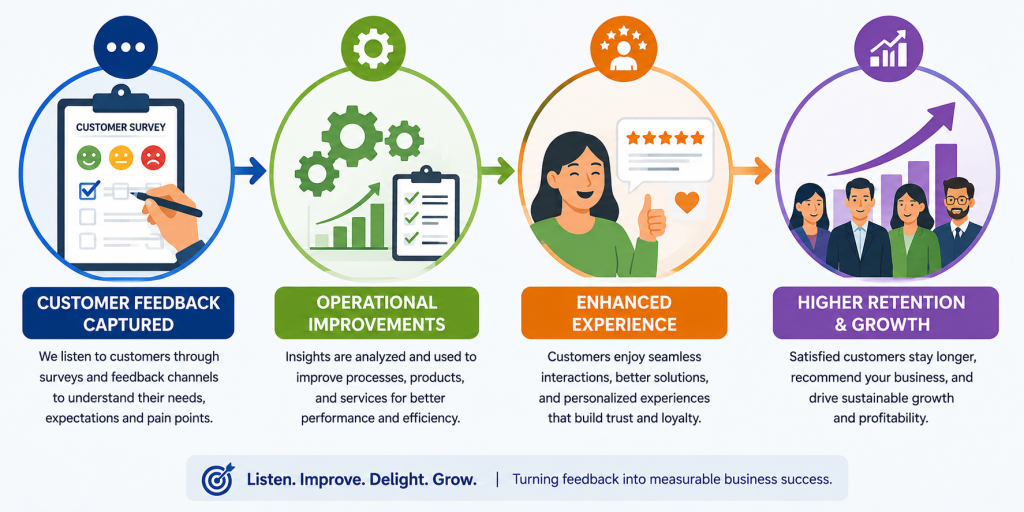
It is an established economic reality that acquiring a new customer can cost anywhere from five to twenty-five times more than retaining an existing one, as highlighted by the Harvard Business Review. Customer satisfaction surveys act as an early-warning system, identifying “at-risk” accounts before they officially cut ties. By catching dissatisfaction early, your account management teams can step in, rectify the issue, and salvage the relationship.
2. Boosted Customer Loyalty and Advocacy
When organizations ask for feedback—and visibly act upon it—customers feel valued and respected. This psychological shift transforms casual buyers into passionate brand advocates. Highly satisfied customers are far more likely to recommend your organization to colleagues and peers, driving organic, low-cost customer acquisition through word-of-mouth networks.
3. Data-Driven Product and Service Refinement
Rather than guessing which features to build next or which services to expand, customer satisfaction surveys give your product development and operations teams clear marching orders. Feedback reveals exactly where your offerings excel and where they fall short, minimizing the financial risks associated with failed product launches.
4. Maximized Upsell and Cross-Sell Opportunities
Satisfied customers are highly receptive to expanded business relationships. By tracking customer satisfaction metrics, sales and account teams can strategically identify which clients are prime candidates for premium upgrades, additional modules, or complementary services, accelerating organic business growth.
Customer Satisfaction Surveys Metrics Every Organization Should Measure
To get the most value out of your research, you must track the right customer satisfaction metrics. Relying on a single metric often provides a skewed view of reality. Instead, leading organizations deploy a strategic mix of specific operational indicators.
Net Promoter Score (NPS)
Developed by Bain & Company, NPS measures long-term brand loyalty and advocacy by asking a simple question: “On a scale of 0 to 10, how likely are you to recommend our company to a friend or colleague?” Respondents are categorized into Promoters (9-10), Passives (7-8), and Detractors (0-6).
Customer Satisfaction Score (CSAT)
CSAT measures a customer’s immediate satisfaction with a specific interaction, product feature, or transaction. It typically asks: “How satisfied were you with your recent experience?” with options ranging from “Very Dissatisfied” to “Very Satisfied.” It is highly transactional and ideal for post-support or post-purchase evaluations.
Customer Effort Score (CES)
Popularized by Gartner, CES evaluates how easy or difficult it was for a customer to interact with your business (e.g., resolving a support ticket or checking out online). Because reducing friction is a massive driver of customer loyalty, minimizing your CES score is crucial for operational efficiency.
| Metric | Primary Focus | Best Used For | Type of Insight |
| Net Promoter Score (NPS) | Long-term relationship & brand loyalty | Executive strategy, board reporting, brand health | Relationship-level |
| Customer Satisfaction Score (CSAT) | Short-term satisfaction with a specific event | Post-purchase, post-onboarding, service desk closure | Transactional-level |
| Customer Effort Score (CES) | Friction reduction and operational ease | Digital touchpoints, self-service portals, customer support | Operational-level |
| Voice of the Customer (VoC) | Qualitative themes, sentiment, deep motivations | Product roadmap, strategic positioning, message testing | Qualitative/Deep-dive |
How to Design Effective Customer Satisfaction Surveys
Creating an impactful survey requires much more than throwing a few random questions together. Poorly designed surveys yield biased data, frustrate users, and damage response rates.
Establish Crystal-Clear Objectives
Before writing a single question, determine exactly what you want to achieve. Are you evaluating your customer onboarding process? Testing a new software update? Or assessing your annual account relationship health? Your core objective must dictate every question you include.
Select the Right Target Audience
Do not blast every survey to your entire database. Segment your respondents based on their behavior, tenure, or demographics. For example, a customer who purchased from you yesterday should receive a very different questionnaire than a legacy client who has been with your enterprise for five years.
Craft Unbiased, Highly Direct Questions
Avoid leading questions that subtly push the respondent toward a positive answer (e.g., “How excellent was our customer service today?”). Instead, keep questions neutral, concise, and focused on a single variable at a time. Avoid double-barreled questions like, “Was our staff helpful and fast?”—a staff member could easily be helpful but slow.
Match Channels to Audience Behavior
Deploy your customer satisfaction surveys through the communication channels your audience uses most.
- In-App/On-Site: Best for immediate digital feedback.
- Email: Excellent for detailed, relationship-level surveys (e.g., NPS).
- SMS: Highly effective for quick, post-delivery or post-retail interactions.
- Phone Intercepts: Ideal for complex B2B engagements requiring deep qualitative insights.
Turning Customer Satisfaction Surveys into Actionable Business Insights
Data collection is merely the first half of the equation. The true value of customer satisfaction surveys is realized when raw data is translated into coordinated organizational action.
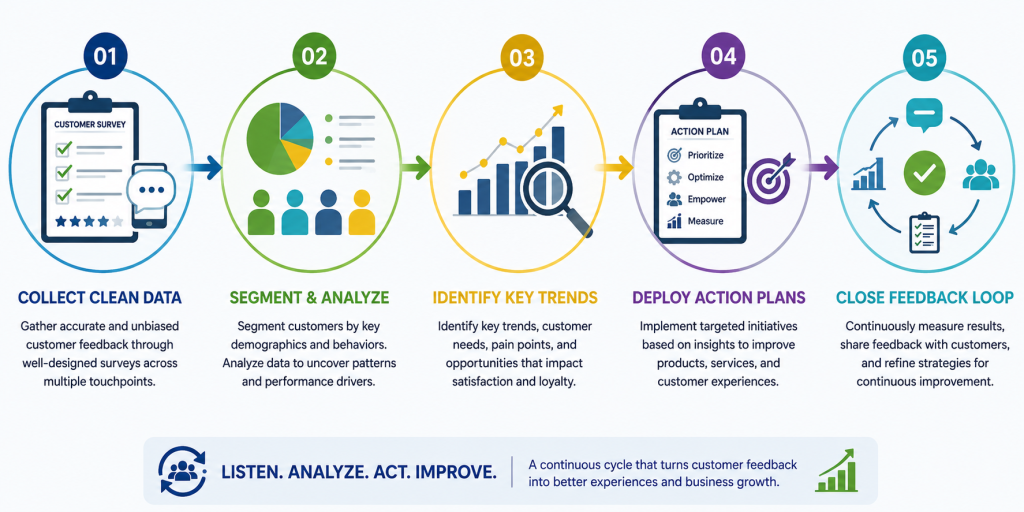
First, use advanced customer analytics to segment responses by customer value, product line, or geographic region. Look past the high-level averages; often, a stable overall CSAT score can hide a severe drop in satisfaction within a highly profitable niche market.
Once you identify systemic issues, prioritize fixes based on their potential impact on your business growth. If feedback consistently shows that your checkout process is overly complicated, your product and engineering teams should prioritize streamlining that user interface.
Most importantly, you must close the feedback loop. Reach out directly to dissatisfied customers who left low scores. Acknowledge their frustration, explain how you are addressing their issue, and thank them for their candor. When customers see that their feedback sparks real operational change, they often transform from critics into loyal, long-term brand champions.
Common Mistakes Organizations Make with Customer Satisfaction Surveys
Even well-meaning companies can run into common pitfalls that compromise their customer research programs.
- Overwhelming Audiences with Survey Fatigue: Bombarding customers with long, repetitive questionnaires after every single interaction causes drop-offs and poor data quality. Keep your surveys lean, focused, and respectful of the user’s time.
- Designing Long, Bloated Questionnaires: A survey should rarely take more than three to five minutes to complete. If a questionnaire drags on for 20 questions, completion rates plummet, and the data you do collect suffers from frustration bias.
- Ignoring Qualitative, Open-Ended Feedback: Quantitative metrics give you the what, but open-ended text fields give you the why. Neglecting to run text analytics on open-ended comments means missing out on the richest insights your customers can offer.
- Failing to Take Visible Action: Collecting data without making internal improvements turns your survey initiative into a hollow bureaucratic exercise. If your target audience feels their feedback goes into a black hole, they will eventually stop responding altogether.
How Market Research and Customer Satisfaction Surveys Work Together
While customer satisfaction surveys focus closely on your current client base, they shouldn’t exist in a vacuum. To unlock sustainable business growth, these insights must connect to a broader, holistic market research program.
By blending internal satisfaction metrics with proactive market research services, organizations gain a comprehensive view of their competitive ecosystem. For instance, while your customer satisfaction survey tracks how your current users feel about your brand, broader consumer behavior analysis reveals why prospective buyers choose your competitors over you.
Furthermore, integrating customer satisfaction surveys with competitive benchmarking helps you understand your true standing in the market. Knowing your NPS is 45 is helpful, but knowing the industry average is 20 changes your entire outlook. This combined data feeds directly into strategic planning, product development, and market segmentation, ensuring your organization stays ahead of market shifts.
Why Businesses Partner with Experts for Customer Satisfaction Surveys
Designing, executing, and interpreting scientifically valid customer satisfaction surveys requires specialized expertise. Many organizations lack the internal infrastructure, data analytics capabilities, or statistical software needed to turn raw sentiment data into robust corporate strategy.
This is why leading enterprises across sectors partner with Novatia Consulting. As a premier management consultancy and market research provider, NOVATIA Consulting brings deep methodologies to your customer experience management initiatives.
Our comprehensive suite of specialized advisory services includes:
- End-to-End Survey Design & Architecture: Crafting scientifically sound, unbiased questionnaires tailored to your unique business objectives.
- Multi-Channel Data Collection: Utilizing advanced, secure platforms to engage your audience across email, web, SMS, and telephone channels.
- Advanced Statistical Analysis & Customer Analytics: Applying advanced statistical techniques to identify key revenue drivers, correlations, and hidden trends.
- Executive Dashboards & Reporting: Building clear, scannable visual interfaces that present complex feedback data as clear business intelligence.
- Integrated Business Strategy: Aligning your customer insights with critical organizational growth drivers, such as our specialized feasibility studies, strategic organizational development solutions, performance-mapped compensation and benchmarking services, and custom corporate training programs.
By partnering with seasoned consulting professionals, you ensure that your investment in customer feedback translates directly into lower churn, optimized operations, and measurable business growth.
Conclusion
In today’s fast-moving business climate, customer satisfaction surveys have shifted from an occasional marketing exercise to an operational absolute. Organizations that build regular, structured channels to listen to their audience protect their revenue, unlock new growth opportunities, and outpace the competition. Conversely, companies that rely on internal assumptions risk falling behind as consumer expectations quickly shift.
True customer centricity requires more than just collecting data—it demands expert analysis, precise strategic alignment, and decisive action.
Looking to understand your customers better and transform feedback into growth? NOVATIA Consulting helps organizations design and implement customer satisfaction surveys that deliver actionable insights and measurable business outcomes. Contact us today to learn more.
Frequently Asked Questions
What is a customer satisfaction survey?
A customer satisfaction survey is a structured research tool used by organizations to measure customer perceptions, happiness, and sentiment regarding their products, services, or overall brand interactions. Its main purpose is to replace assumptions with empirical data, allowing organizations to spot operational issues and improve the buyer’s journey.
Why are customer satisfaction surveys important?
They are important because they give businesses a direct look at customer health, loyalty, and pain points. By regularly gathering this data, companies can make smart, customer-focused updates that lower acquisition costs, boost retention, fix product vulnerabilities, and unlock new revenue streams.
How often should businesses conduct customer satisfaction surveys?
Frequency depends on the type of survey. Relationship-focused evaluations, like an annual NPS, are usually sent out quarterly or bi-annually. In contrast, transactional surveys—like post-purchase or support desk evaluations—should be triggered automatically right after the interaction occurs to capture fresh, accurate impressions.
What metrics are used to measure customer satisfaction?
The three primary metrics are Net Promoter Score (NPS) for long-term brand loyalty, Customer Satisfaction Score (CSAT) for immediate satisfaction with a specific transaction, and Customer Effort Score (CES) to measure how easy it is for customers to interact with your business.
How can customer satisfaction surveys increase revenue?
These surveys boost revenue by revealing exactly how to stop customer churn, identifying happy clients ready for upsells, and lowering acquisition costs through positive word-of-mouth. They also guide product development based on real consumer demand, ensuring higher returns on your R&D investments.


