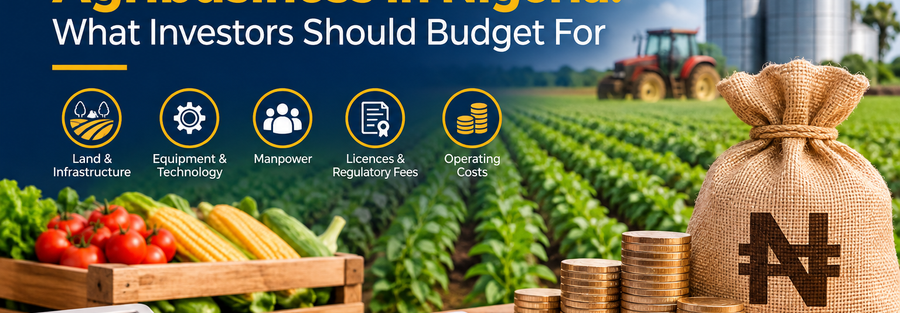
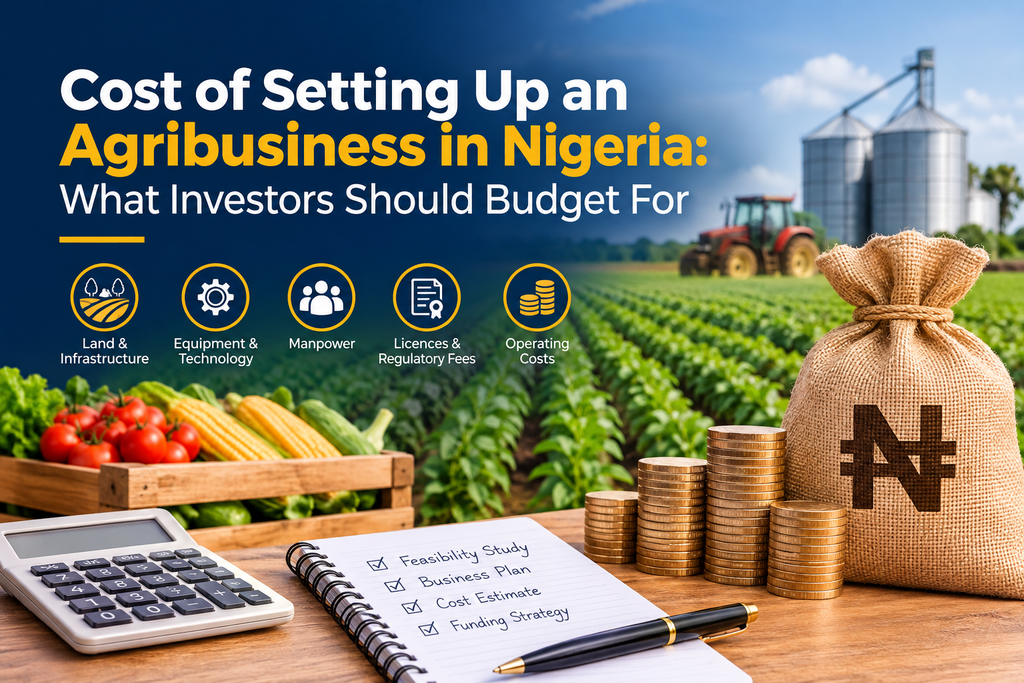
The cost of setting up an agribusiness in Nigeria depends on the type of agricultural venture, proposed production capacity, location, land requirements, technology, infrastructure and operating model.
An investor establishing a small poultry farm, for example, will have significantly different capital requirements from an entrepreneur developing a commercial rice farm, fish production facility or industrial agro-processing plant.
Consequently, there is no single cost applicable to every agribusiness investment. A proper cost assessment must consider both the initial investment required to establish the business and the working capital needed to sustain operations until the business begins generating sufficient revenue.
Key Factors That Determine the Cost of Setting Up an Agribusiness
Several cost components should be considered when preparing an agricultural investment budget.
| Cost component | What it covers |
|---|---|
| Land acquisition or lease | Purchase, lease, survey, documentation and land preparation |
| Infrastructure | Farm buildings, fencing, access roads, drainage, water supply and irrigation |
| Machinery and equipment | Tractors, processing machines, pumps, generators and production equipment |
| Production inputs | Seeds, seedlings, fertilisers, agrochemicals, livestock, fingerlings and animal feed |
| Labour | Farm workers, supervisors, technical personnel and management |
| Storage and logistics | Warehousing, cold storage, transportation and distribution |
| Regulatory requirements | Applicable permits, certifications and environmental compliance |
| Working capital | Recurring expenses required to sustain operations |
| Contingency | Provision for unexpected costs and price fluctuations |
An important consideration is that investors should distinguish between establishment costs and working capital. A business may have sufficient funding to construct a farm or processing facility but lack the resources to sustain production until revenue is generated.
Estimated Cost of Setting Up Different Agribusinesses in Nigeria
The following examples illustrate how investment requirements differ across agricultural enterprises.
| Agribusiness type | Main cost considerations |
|---|---|
| Commercial crop farming | Land, clearing, mechanisation, seeds, fertilisers, irrigation and harvesting |
| Poultry farming | Housing, chicks, cages, feeders, drinkers, feed and veterinary care |
| Fish farming | Ponds or tanks, fingerlings, feed, water systems and aeration |
| Livestock farming | Housing, breeding stock, feed, veterinary services and equipment |
| Cassava farming | Land preparation, stems, labour, fertilisers, herbicides and harvesting |
| Agro-processing | Factory development, processing machinery, power, raw materials and packaging |
| Rice milling | Processing equipment, warehouse, paddy procurement, utilities and distribution |
For context, published 2026 estimates put a 500–1,000-bird poultry operation at approximately ₦3.5 million–₦9 million, depending on the production model and facilities. A 2025 cassava farming estimate places initial production costs at approximately ₦250,000–₦2 million per acre, depending on location and scale. These are indicative published estimates, not independently verified quotations or comprehensive commercial project budgets. Legit.ng – Nigeria news.+1
How to Determine the Actual Cost of an Agribusiness Investment
Before committing capital, investors should undertake a detailed assessment of the proposed business.
A professional feasibility study should establish:
- Investment scale: Determine the proposed production capacity, farm size or processing volume.
- Location: Assess land costs, accessibility, infrastructure and proximity to suppliers and markets.
- Technical requirements: Identify machinery, equipment, technology and production infrastructure.
- Production economics: Estimate input requirements, production costs, yields and operating expenses.
- Market potential: Evaluate demand, selling prices, competition and distribution opportunities.
- Financial projections: Develop projected revenue, cash flows, profitability and investment returns.
- Risk assessment: Evaluate the impact of changing input prices, production yields, commodity prices and other operating risks.
Investors should also obtain current supplier quotations and validate projected selling prices with prospective buyers before finalizing their investment budgets.
Why a Feasibility Study Is Important Before Committing Capital
One of the common mistakes in agricultural investment is determining the required capital based on the cost of land, machinery or initial production inputs alone.
This approach can underestimate the actual investment requirement.
For instance, establishing an agro-processing facility requires more than purchasing processing equipment. Investors must also consider raw material procurement, electricity, water, labour, packaging, storage, transportation and the working capital required to maintain production.
A feasibility study for agribusiness in Nigeria provides a comprehensive assessment of these requirements and determines whether the proposed investment can generate sufficient returns to justify the capital expenditure.
Novatia The cost of setting up an agribusiness in Nigeria depends on the type of venture, the scale of production and the location. It also depends on land needs, technology, infrastructure and how you plan to run the business. So there is no single price tag. A small poultry farm and an industrial agro-processing plant sit at opposite ends of the budget scale.
This article breaks the numbers into clear parts. You will see what to budget for, how costs differ across common ventures and how to get a figure you can trust. Because many investors underestimate their capital needs, we also show where the hidden costs sit.
What Determines the Cost of Setting Up an Agribusiness in Nigeria?
Five things drive most budgets.
The first is the type of business. Growing crops, rearing birds, farming fish and processing food each need different assets. The second is scale. Ten hectares and 1,000 hectares are very different projects.
Location comes third. Land prices, road access, power supply and distance to buyers all change your costs. A cheap plot far from a market can cost more in the long run.
The fourth driver is technology. A manual operation costs less to start. A mechanized one costs more upfront but may cut labour later. Finally, your operating model matters. Will you own the land or lease it? Will you buy raw materials or grow them? Each choice moves the budget.
As a result, a proper cost assessment must cover two things. One is the money needed to build the business. The other is the money needed to keep it running until sales cover expenses.
Key Cost Components in an Agricultural Investment Budget
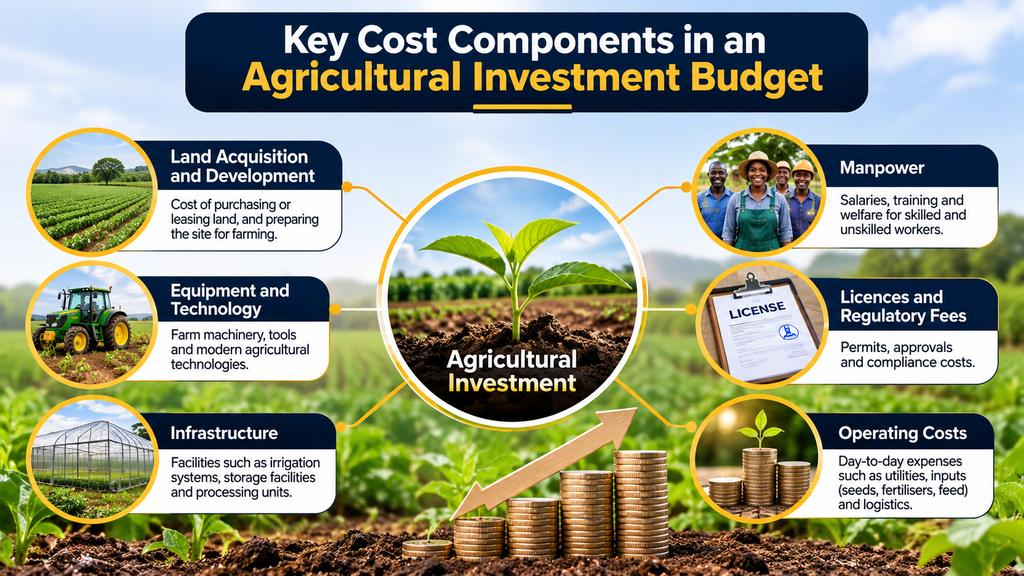
Several cost lines belong in every agricultural investment budget. The table below sets them out.
| Cost component | What it covers |
|---|---|
| Land acquisition or lease | Purchase, lease, survey, documentation and land preparation |
| Infrastructure | Farm buildings, fencing, access roads, drainage, water supply and irrigation |
| Machinery and equipment | Tractors, processing machines, pumps, generators and production equipment |
| Production inputs | Seeds, seedlings, fertilisers, agrochemicals, livestock, fingerlings and animal feed |
| Labour | Farm workers, supervisors, technical staff and management |
| Storage and logistics | Warehousing, cold storage, transport and distribution |
| Regulatory requirements | Permits, certifications and environmental compliance |
| Working capital | Recurring expenses needed to sustain operations |
| Contingency | Provision for unexpected costs and price changes |
Many first-time investors budget for the top three rows only. Then they run short of cash when feed, fuel or wages come due. A full list protects you from that surprise.
Establishment Costs vs Working Capital: A Distinction Investors Often Miss
Establishment costs are the one-off expenses to build the business. Think of land, buildings, equipment and the first batch of inputs. Working capital is different. It covers the recurring bills you pay while you wait for income.
This gap catches many people. A business may have enough money to build a farm or a processing plant. Yet it may lack the cash to run production until the first sales arrive.
Consider a fish farmer who builds six ponds and stocks them. Fingerlings need feed every day for months before harvest. If the money for feed runs out in month three, the whole stock is at risk.
So when you plan the cost of setting up an agribusiness in Nigeria, set aside working capital for the full period before revenue. Crops have long gaps between planting and harvest. Livestock and fish have shorter but still real gaps. Processing plants need raw material stock before the first sale.
Estimated Cost of Setting Up Different Agribusinesses in Nigeria
The table below shows what drives costs in each common venture. It does not give prices. It shows where your money will go.
| Agribusiness type | Main cost considerations |
|---|---|
| Commercial crop farming | Land, clearing, mechanisation, seeds, fertilisers, irrigation and harvesting |
| Poultry farming | Housing, chicks, cages, feeders, drinkers, feed and veterinary care |
| Fish farming | Ponds or tanks, fingerlings, feed, water systems and aeration |
| Livestock farming | Housing, breeding stock, feed, veterinary services and equipment |
| Cassava farming | Land preparation, stems, labour, fertilisers, herbicides and harvesting |
| Agro-processing | Factory development, processing machinery, power, raw materials and packaging |
| Rice milling | Processing equipment, warehouse, paddy procurement, utilities and distribution |
For context, published 2026 estimates put a 500 to 1,000-bird poultry operation at about ₦3.5 million to ₦9 million. The range depends on the production model and the facilities. A 2025 cassava farming estimate places initial production costs at about ₦250,000 to ₦2 million per acre, depending on location and scale.
Treat these as indicative figures only. They are published estimates. They are not verified quotations, and they are not full commercial project budgets. Always confirm current prices with suppliers before you commit.
Cost of Setting Up a Poultry Farm in Nigeria
Poultry is a popular entry point because you can start small. Even so, the budget has several parts. You need housing, chicks, cages, feeders and drinkers. Then you need feed and veterinary care.
The published range of ₦3.5 million to ₦9 million for 500 to 1,000 birds shows how wide the spread can be. A basic deep-litter setup sits at the lower end. A better-equipped house with more control over heat and ventilation costs more.
Watch the running costs closely. Feed is often the largest recurring expense. Power for brooding and water supply add to it. Disease can wipe out a flock, so veterinary support is not optional.
Before you buy a single chick, check who will buy your birds and eggs. Then compare your expected selling price with your full cost per bird. That one comparison tells you a lot.
Cost of Setting Up a Cassava Farm in Nigeria
Cassava is a staple with steady demand. It is also a common start for investors who want to grow food crops. The cost per acre depends heavily on location and scale.
The published 2025 estimate of about ₦250,000 to ₦2 million per acre covers a wide span. The low end suggests a basic, labour-led approach. The high end points to more inputs and more mechanization.
Your main cost lines are land preparation, planting stems, labour, fertiliser, herbicides and harvesting. Transport to the buyer or processor can also take a big share. Cassava spoils quickly after harvest, so you need a buyer lined up before you dig.
If you plan to process cassava into flour, starch or garri, your budget changes. You then add machines, power, packaging and regulatory approvals.
Cost of Fish Farming, Rice Milling and Agro-Processing
These ventures need more infrastructure than most crop projects.
Fish farming. You need ponds or tanks, fingerlings, feed, water systems and aeration. Water quality drives survival rates, so spend on it wisely. Feed is the main running cost.
Rice milling. Equipment is the headline cost. However, you also need a warehouse, a steady supply of paddy, utilities and a way to distribute the milled rice. Paddy purchases tie up a lot of cash, especially at harvest time.
Agro-processing. This is the most capital-heavy option. You must pay for the factory, the machinery and reliable power. Then you need raw materials, packaging and storage. Most packaged foods also need NAFDAC registration, which takes time and money.
In all three cases, the machines are only part of the bill. The cost of setting up an agribusiness in Nigeria at industrial scale includes the whole system around the machines.
Hidden Costs That Investors Often Overlook
Some costs do not show up in a first draft. They still hurt when they arrive.
- Power: Grid supply can be unreliable. Many sites need a generator or solar backup, plus fuel and servicing.
- Exchange rate and inflation: Imported machinery, feed ingredients and chemicals can rise in price quickly. Track the Central Bank of Nigeria for rate trends.
- Transport and storage: Poor roads raise haulage costs. Weak storage leads to spoilage.
- Documentation: Land titles, surveys, permits and certifications take time and fees.
- Seasonality: Prices of produce and inputs swing across the year. This affects both your costs and your sales.
- Delays: A late delivery or a slow approval means you pay staff and bills with no output.
A contingency line in your budget covers many of these. Do not leave it out.
How to Determine the Actual Cost of an Agribusiness Investment
Before you commit capital, assess the proposed business in detail. A professional feasibility study should work through these steps:
- Investment scale: Set the planned production capacity, farm size or processing volume.
- Location: Check land costs, access, infrastructure and distance to suppliers and markets.
- Technical requirements: List the machinery, equipment, technology and production facilities.
- Production economics: Estimate input needs, production costs, yields and operating expenses.
- Market potential: Review demand, selling prices, competition and distribution options.
- Financial projections: Build projected revenue, cash flow, profit and investment returns.
- Risk assessment: Test how changes in input prices, yields and commodity prices affect results.
Also, get current quotes from suppliers. Then check your expected selling prices with real buyers. Numbers from a brochure or a friend are a starting point, not a budget.
For current sector data, you can also check the National Bureau of Statistics and the FAO Nigeria office.
How to Keep Startup Costs Under Control
Lower costs should not mean weaker foundations. Still, a few sensible choices can reduce pressure on your cash.
Start at a scale you can manage. You can expand once the first cycle proves your numbers. Lease land before you buy it if the site is untested. Buy equipment that local technicians can repair. Source inputs from more than one supplier so you are not stuck with one price.
Also look at funding support. The Bank of Agriculture and NIRSAL work with agricultural borrowers. Lenders will ask for a clear budget and a credible plan, so a good study helps you here too.
Finally, phase your spending. Build what you need for the first cycle. Add more as income arrives.
Why a Feasibility Study Matters Before You Commit Capital
One common mistake is to base the budget on land, machines or the first inputs alone. This approach can understate the real investment needed.
Take an agro-processing facility. Buying the equipment is only one step. You must also pay for raw materials, electricity, water, labour, packaging, storage and transport. Then you need working capital to keep production going.
A feasibility study for agribusiness in Nigeria pulls all these pieces together. It shows the true cost of setting up an agribusiness in Nigeria and tests whether the returns justify the spend. For a full walk-through, read our guide to the feasibility study for agribusiness in Nigeria.
How Novatia Consulting Can Help You Budget with Confidence
Novatia Consulting provides feasibility studies, agricultural market research, financial modelling and investment appraisal services. We help investors assess agricultural and agro-industrial opportunities in Nigeria.
Our reports give you clear cost breakdowns, realistic revenue forecasts and honest risk findings. You see what to spend, when to spend it and what return to expect. Learn more about our market research services.
Ready to put real numbers on your idea? Contact Novatia Consulting to discuss the feasibility of your proposed agricultural investment.
Frequently Asked Questions About the Cost of Setting Up an Agribusiness in Nigeria
How much does it cost to set up an agribusiness in Nigeria? The cost varies by venture, scale and location. A small poultry farm needs far less than a commercial rice farm or an agro-processing plant, so get a project-specific budget.
What is the cost of starting a poultry farm in Nigeria? Published 2026 estimates put a 500 to 1,000-bird operation at about ₦3.5 million to ₦9 million. The final figure depends on the production model and facilities.
How much does it cost to start cassava farming in Nigeria? A 2025 estimate places initial production costs at about ₦250,000 to ₦2 million per acre. Location and scale drive the difference.
What is the difference between establishment costs and working capital? Establishment costs build the business. Working capital pays for running costs until sales begin.
What costs do investors often forget? Power, transport, storage, permits and price changes are common gaps. A contingency line helps cover them.
How can I estimate the cost of an agribusiness accurately? Get current supplier quotes and test selling prices with real buyers. A feasibility study then ties all the figures together.
Is a feasibility study necessary before investing? Yes. It shows the full capital need and whether returns justify the spend.
Can I start an agribusiness in Nigeria with a small budget? Yes. Start small, lease land first and expand as income grows.
Final Thoughts: Budget for the Whole Business, Not Just the Build
The cost of setting up an agribusiness in Nigeria is more than land and equipment. It includes inputs, labour, logistics, compliance and the cash to carry you to your first sale.
So build your budget from the ground up. Check every figure with suppliers and buyers. Then test it in a feasibility study before you commit. That discipline can keep a promising idea from turning into an expensive lesson.Consulting provides feasibility studies, agricultural market research, financial modelling and investment appraisal services to help investors evaluate agricultural and agro-industrial opportunities in Nigeria.
Contact Novatia Consulting to discuss the feasibility of your proposed agricultural investment.