
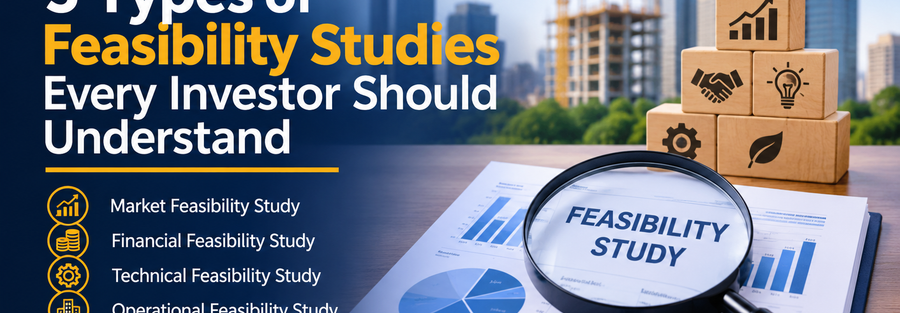

The types of feasibility studies you choose decide how well you can judge an investment before you commit money. Each type tests a different part of your idea. One checks demand. Another checks whether you can build it. Others test profit, daily operations and the law.
Many investors run only a financial check and stop there. That is a risky habit. A project can look profitable on paper and still fail because nobody buys the product, or because a permit never arrives.
This article explains the five main types of feasibility studies in plain language. You will see what each one covers, when to use it and how they fit together. We also share local points for investors in Nigeria.
What Are the Types of Feasibility Studies and Why Do They Matter?
A feasibility study is a structured review of a business idea or project. It asks a direct question. Can this work, and is it worth the money?
The different types of feasibility studies break that big question into smaller ones. Each type looks at one area of risk. Together, they give you a full picture of the project.
Why does this matter? Because investors rarely lose money from one big mistake. More often, a small gap in one area grows over time. A weak market estimate leads to low sales. Low sales then strain cash flow. Before long, the whole project is in trouble.
A good study helps you spot these gaps early. It also gives lenders, partners and boards the evidence they want. As a result, you can raise funds with more confidence and make decisions with less guesswork.
Types of Feasibility Studies at a Glance
Here is a quick view of the five types and the question each one answers.
| Type | Key question | What it reviews |
|---|---|---|
| Market feasibility | Will customers buy? | Demand, competition, pricing and distribution |
| Technical feasibility | Can we build and deliver it? | Location, technology, equipment and capacity |
| Financial feasibility | Will it make money? | Costs, revenue, cash flow and returns |
| Operational feasibility | Can we run it day to day? | People, processes, suppliers and systems |
| Legal and regulatory feasibility | Are we allowed to do it? | Licences, permits, land and compliance |
Some writers list more types, such as scheduling or economic feasibility. However, these five cover the areas investors need most. We explain each below.
Type 1: Market Feasibility Study, or Is There Real Demand?
A market feasibility study tests whether enough people will pay for your product at a price that works. It is often the first of the types of feasibility studies to run. After all, a project without buyers has no future.
This study looks at several things:
- Customer needs: Who will buy, and why?
- Market size: How many buyers exist, and is the number growing?
- Competition: Who already serves them, and how well?
- Pricing: What will customers pay, and what do rivals charge?
- Distribution: How will your product reach buyers?
Consider a founder who plans a cold storage facility. She assumes every nearby trader needs it. A market assessment shows that most traders already share a cheaper facility. Her plan changes before she spends anything.
Good market research mixes desk research with field work. Talk to real buyers. Visit the markets. Ask what they would change. You can see how we approach this on our market research page.
Type 2: Technical Feasibility Study, or Can You Build and Deliver It?
Technical feasibility checks whether your project can work in practice. It looks at the physical and technical side of the plan.
The study reviews location, land, utilities, equipment, technology and production capacity. It also checks access roads, power supply and water. In Nigeria, power and logistics often decide whether a site works or not.
For example, a food processor may find a perfect plot. Then the study shows that the grid is unreliable and the road floods each rainy season. Those facts change the budget and the schedule.
This part of the project feasibility study also asks about skills. Can local technicians repair your machines? Are spare parts easy to find? A machine that sits idle for lack of parts is a hidden cost.
Finally, the study matches capacity to demand. Building too big wastes capital. Building too small loses sales. The technical findings feed straight into the cost estimates, so this step matters for the next type.
Type 3: Financial Feasibility Study, or Will the Project Pay Back?
Financial feasibility turns the plan into numbers. It is the part most investors know best. Still, it only works well when the earlier studies feed it good data.
A sound financial review includes:
- Startup costs: Land, buildings, equipment and the first stock.
- Operating costs: Wages, fuel, materials, transport and licences.
- Revenue forecasts: Realistic prices and volumes, not the best case.
- Cash flow: When money comes in and when it goes out.
- Returns: Return on investment (ROI), payback period and internal rate of return.
- Sensitivity tests: What happens if costs rise or prices fall?
This is the core of any investment appraisal. It shows commercial viability in figures. It also shows how much working capital you need to survive the early months.
In Nigeria, exchange rates and inflation deserve extra attention. Imported inputs can jump in price. Wages and fuel can rise too. For trend data, check the Central Bank of Nigeria.
For a worked example of costs in one sector, read our article on the cost of setting up an agribusiness in Nigeria.
Type 4: Operational Feasibility Study, or Can Your Team Run It?
A project may be technically sound and financially attractive. Even so, it can fail if the team cannot run it well. Operational feasibility tests that risk.
The study looks at your people, processes and supply lines. Do you have the right skills? Can you hire and keep them? Who will manage the site every day?
It also checks your suppliers. Will they deliver on time and at the quoted price? What happens if one of them fails? A single weak link can stop production.
Next, it reviews systems. Do you have record-keeping, quality control and reporting in place? Many young businesses grow faster than their systems. Then problems appear in stock, billing or customer service.
In short, this study asks whether the plan is realistic for the people who must carry it out. It often shows training or hiring needs that were missing from the first budget.
Type 5: Legal and Regulatory Feasibility Study, or Are You Allowed to Do It?
Legal feasibility checks whether you can lawfully run the business where you plan to. Many investors leave this to the end. That is a mistake, because a missing approval can stop a project cold.
The review covers company registration, land titles, licences and sector rules. It also looks at tax duties, environmental rules, labour law and product approvals. For example, you may need to register with the Corporate Affairs Commission. Food products usually need NAFDAC approval. Foreign investors may also work with the Nigerian Investment Promotion Commission.
Land deserves special care. A weak title or a dispute can freeze a project for years. Check ownership early and get proper documents.
Rules also change. A new duty, import restriction or tax can alter your margins. So the study should flag which rules carry the most risk and how you will respond.
How the Types of Feasibility Studies Work Together
Each study is useful alone. However, the real value comes from reading them together.
Market findings set your sales target. The technical study then shows what it takes to reach that target. The financial model prices both. The operational review tests whether your team can deliver. Finally, the legal review confirms you may proceed.
A weak result in one area can change the whole plan. Say the market study shows lower demand than you hoped. Your capacity shrinks, costs fall and the returns change. If you had checked only the financials, you would have missed the cause.
This is why a full feasibility study report covers all five areas. It ends with a clear verdict: go, adjust or stop. Any of the three can be a good result. Stopping a weak project early saves real money.
To see all the types of feasibility studies applied to one sector, read our guide to the feasibility study for agribusiness in Nigeria.
How to Choose Which Types of Feasibility Studies You Need
Not every project needs the same depth. Your choice depends on the size, risk and stage of your plan.
For a small, low-risk idea, a light market and financial check may be enough. For a large factory, farm or real estate project, you need all five types in full. Lenders will usually ask for that.
Here are a few simple guides:
- New market or product: Put market feasibility first.
- Heavy equipment or new technology: Give extra weight to technical feasibility.
- Tight funding: Focus on financial feasibility and cash flow.
- Fast growth or new sites: Test operational feasibility closely.
- Regulated sector: Start the legal review early.
If you are unsure, begin with a short screening. It can show which areas carry the most risk. Then you can spend your budget where it counts.
Common Mistakes Investors Make With Feasibility Studies
Even good investors slip up. Watch for these habits.
- Starting with the answer. Some people write the study to prove a decision they already made. A study should test the idea, not decorate it.
- Using only one type. A strong financial model cannot rescue a weak market.
- Trusting rough numbers. Get real supplier quotes and buyer feedback.
- Ignoring working capital. Cash gaps sink many sound projects.
- Skipping risk tests. Always ask what happens if prices fall or costs rise.
- Filing the report and forgetting it. Update the study when conditions change.
Honest studies sometimes bring bad news. That is not a failure. It is the whole point.
Applying the Types of Feasibility Studies in Nigeria: Local Factors to Weigh
Nigeria offers large markets and real openings. It also brings its own challenges. So local knowledge matters in every type of study.
On the market side, demand varies by state, income level and season. A product that sells well in Lagos may need a different price in Kano. On the technical side, power, roads and water shape site choices. On the financial side, the naira and inflation can move your budget quickly.
Operational plans must reflect labour supply, security and logistics. Legal reviews must cover federal and state rules, land titles and sector regulators. For national data, the National Bureau of Statistics is a good starting point.
Cultural habits matter too. Buyers often prefer trusted suppliers and personal relationships. A study that ignores this can overstate how fast a new brand will grow.
Why Work With Professional Feasibility Study Consultants?
You can draft a basic study in-house. Still, outside experts bring fresh eyes and local data. They also have no emotional stake in the result.
That independence matters. Owners often love their projects, which can blur judgment. A consultant will question your assumptions and test your numbers. As a result, the findings carry more weight with lenders and partners.
Experienced advisers also save time. They already know the price trends, buyer networks and approval steps. That shortens the work and reduces errors.
Before hiring, ask about the method. A good consultant shows how they collect data, test risks and reach a verdict.
How Novatia Consulting Supports Your Investment Decisions
Novatia Consulting is a management consulting, market research and corporate advisory firm based in Abuja. We work with clients across Nigeria and the wider African market. They range from multinationals and energy companies to local enterprises.
We support investors with market assessment, financial modelling, investment appraisal and business proposal development. Our reports are clear and practical. You get firm numbers, honest risk findings and a direct recommendation.
Our market entry advisory and business proposal development services help you turn study findings into action.
Ready to test your next investment? Contact Novatia Consulting to discuss the right types of feasibility studies for your project.
Frequently Asked Questions About the Types of Feasibility Studies
What are the main types of feasibility studies? The five main types are market, technical, financial, operational and legal feasibility. Each tests a different area of project risk.
Which of the types of feasibility studies should I run first? Start with market feasibility. If there is no demand, the other studies add little.
What is the difference between technical and operational feasibility? Technical feasibility asks if you can build and deliver the project. Operational feasibility asks if your team can run it day to day.
What does a financial feasibility study include? It covers startup costs, operating costs, revenue forecasts, cash flow and returns such as ROI. It also tests how results change when prices or costs move.
Why is legal feasibility important for investors? A missing licence, weak land title or new rule can halt a project. Early legal checks prevent costly delays.
Do I need all the types of feasibility studies for a small business? Not always. A small, low-risk idea may need only market and financial checks, while large projects need all five.
How long does a feasibility study take? Most take several weeks. Complex projects with field surveys take longer.
Can a feasibility study tell me to stop a project? Yes. A clear “no” can save you far more than the cost of the study.
Final Thoughts: Test the Idea Before You Fund It
The five types of feasibility studies give you five ways to check a project before it costs you real money. Market, technical, financial, operational and legal reviews each catch a different risk. Together, they show whether your plan can stand up in practice.
So do not rely on one number or one opinion. Test the demand, the build, the profit, the team and the law. Then decide with your eyes open.
Related posts:
 Discovering the Best Market Research Companies in Africa – Novatia Consulting Leads the Way!
 A Comprehensive Look At Novatia Consulting’s Services In Nigeria
Energy Efficiency & Resource Management Consulting In Nigeria – Novatia Consulting
 The Importance Of Ethics And Integrity In Management Consulting: Novatia Consulting’s Approach In Nigeria