


💡 KEY TAKEAWAYS
- Organizations that invest in research consistently outperform peers in strategic decision-making speed and accuracy.
- Market research, feasibility studies, and customer satisfaction surveys are essential tools for evidence-based strategy.
- Data-driven organizations reduce investment risk and allocate resources more effectively than those relying on assumptions.
- Compensation benchmarking is a critical—yet often overlooked—component of organizational strategic planning.
- Partnering with specialized research experts accelerates insight generation and competitive advantage.
Strategic decisions are stronger, faster, and more effective when organizations invest in research and data-driven insights rather than assumptions. In today’s rapidly shifting business landscape characterized by volatile markets, intensifying competition, and evolving customer behavior, operating on gut instinct alone is a liability that few organizations can afford.
Uncertainty is the defining challenge of modern business. Consumer preferences shift overnight. New competitors emerge from unexpected directions. Regulatory landscapes change. Economic conditions fluctuate. Against this backdrop, organizations that ground their strategic planning in rigorous research don’t just navigate uncertainty better, instead they transform it into competitive advantage.
According to McKinsey & Company, data-driven organizations are 23 times more likely to acquire customers and 19 times more likely to be profitable. Research is not a cost center, rather it is a strategic investment that pays dividends across every function of the business.
Why Strategic Decisions Depend on Reliable Research
At the core of every successful organization lies a commitment to evidence-based management. Strategic decisions made without reliable data are, at best, expensive gambles. At worst, they destroy value, damage reputation, and cost organizations their competitive standing.
| Why is research important for strategic decisions? Research is important for strategic decisions because it replaces assumptions with evidence, reduces uncertainty, and surfaces insights that leaders cannot obtain from intuition alone. By understanding market dynamics, customer behavior, and competitive positioning, organizations make informed choices that minimize risk and maximize the probability of success. |
The shift from intuition-based to evidence-based decision-making reflects a fundamental change in what constitutes good management. Research published in the Harvard Business Review consistently demonstrates that evidence-based management practices correlate strongly with superior organizational outcomes.
Data vs. Assumptions: A Critical Distinction
Assumptions feel efficient. They allow leaders to move quickly without investing time or resources in information gathering. But the speed gained through assumption-based decisions is typically illusory, poor strategic choices consume far more organizational energy in course correction than research would have cost in the first place.
- Research reveals what customers actually value, not what executives assume they value.
- Research identifies market trends early, enabling proactive rather than reactive strategy.
- Research quantifies risk, enabling informed trade-offs rather than blind leaps.
- Research validates or invalidates strategic hypotheses before significant capital is deployed.
How Market Research Improves Strategic Decisions
Effective market research services give organizations a 360-degree view of their competitive environment. From understanding customer behavior to mapping market trends and analyzing competitive dynamics, market research translates raw data into strategic intelligence.
Customer Behavior Analysis
Understanding why customers buy, what drives their loyalty, and what causes them to switch to competitors is foundational intelligence for any strategic decision. Market research tools—from focus groups and ethnographic studies to large-scale quantitative surveys—provide the behavioral insights that make customer-centric strategy possible.
Market Trends and Emerging Opportunities
Markets evolve. Organizations that monitor trends through systematic research identify opportunities earlier, position more effectively, and avoid being caught off-guard by disruption. Gartner‘s research consistently shows that organizations with structured market intelligence functions adapt to change significantly faster than those without.
Competitor Intelligence
Competitive analysis is not corporate espionage, it is disciplined observation. Understanding competitor positioning, pricing strategies, product roadmaps, and customer perception enables organizations to differentiate effectively and defend market share.
Market Segmentation and Product Innovation
Research-driven segmentation allows organizations to allocate marketing and product development resources to the highest-value opportunities. Rather than building products for imagined customers, research-driven organizations build for real, identified segments, dramatically improving product-market fit and launch success rates.
For example, a consumer goods company expanding into West Africa might assume urban middle-class consumers are its primary target. Market research might reveal that a fast-growing aspirational segment in secondary cities offers higher margins and lower competitive intensity, a strategic pivot that only research could surface.
Strategic Decisions Become More Effective with Data-Driven Insights
Business intelligence and advanced analytics have elevated the quality of strategic decisions across industries. Organizations that build robust data capabilities—integrating business intelligence platforms, predictive modeling, and real-time analytics, gain a persistent strategic advantage over competitors operating on lagging information.
Comparison: Research-Driven vs. Assumption-Based Organizations
| Organizations That Use Research | Organizations That Rely on Assumptions |
| Reduced investment risk through evidence-based validation | Higher uncertainty and exposure to avoidable losses |
| Better capital allocation to proven opportunities | Poor resource allocation driven by internal politics or guesswork |
| Stronger customer understanding and empathy | Weak market knowledge and misaligned product offerings |
| Faster, more confident response to market change | Slow adaptation due to lack of early warning signals |
| Predictive insights enabling proactive strategy | Reactive posture, always catching up to the market |
| Higher ROI on marketing and product development | Wasted spend on initiatives that miss the mark |
According to Deloitte Insights, organizations that invest in analytics capabilities are twice as likely to report top-quartile financial performance in their industries. The data is unambiguous: research and analytics investment generates measurable strategic returns.
Risk Mitigation and Resource Allocation
Every strategic decision involves trade-offs. Research sharpens those trade-offs by quantifying risks and opportunity costs. Organizations that deploy business intelligence systems and conduct regular market assessments allocate capital more efficiently, reduce waste, and build financial resilience.
How Customer Satisfaction Surveys Support Strategic Decisions
The voice of the customer is among the most powerful inputs available to strategic leaders. Systematic customer satisfaction surveys capture that voice at scale, translating thousands of individual customer experiences into actionable strategic intelligence.
Voice of Customer Programs
Best-in-class organizations don’t just measure customer satisfaction as a report card, they embed customer feedback loops into their strategic planning cycles. Net Promoter Score (NPS), Customer Satisfaction Score (CSAT), and Customer Effort Score (CES) provide leading indicators of revenue performance and churn risk.
Customer Retention and Loyalty
It costs five to seven times more to acquire a new customer than to retain an existing one. Customer satisfaction research identifies the specific service gaps, product shortfalls, and experience failures that drive churn, enabling organizations to intervene before customers leave. Bain & Company research shows that increasing customer retention by just 5% can increase profits by 25% to 95%.
Service Improvement and Customer Experience Management
Customer satisfaction data also drives continuous improvement. When systematically analyzed, survey data reveals patterns in service failures, preference shifts, and unmet needs—all of which inform strategic decisions about product development, service design, and customer experience investments.
For example, a financial services firm conducting quarterly customer satisfaction surveys might discover that clients in a specific segment consistently rate digital onboarding as a pain point. This insight directly informs a strategic decision to invest in UX improvement, a decision with measurable impact on acquisition and retention.
Why Feasibility Studies and Market Surveys Matter for Strategic Decisions
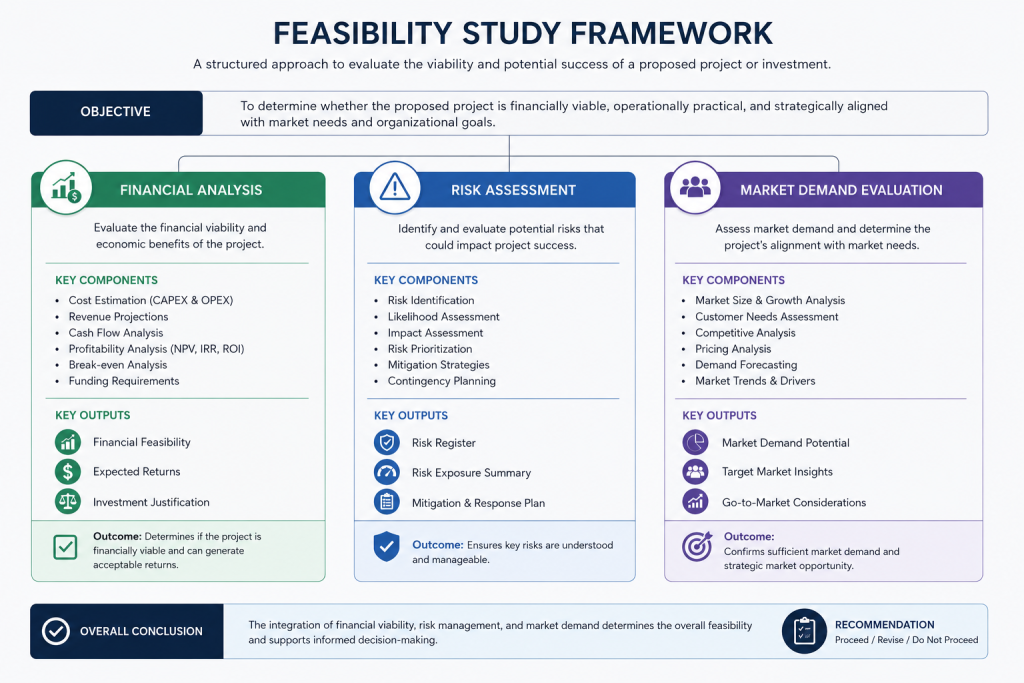
Before organizations commit significant capital to a new market, product, or business unit, a thorough feasibility study and comprehensive market survey are essential due diligence. These tools transform strategic ambition into evidence-based business cases.
Our feasibility studies provide organizations with a rigorous framework for evaluating project viability before resources are committed.
What a Feasibility Study Covers
- Financial analysis: revenue projections, cost structures, break-even timelines, and capital requirements
- Market demand assessment: size of opportunity, growth trajectory, and competitive saturation
- Operational requirements: infrastructure, human capital, technology, and supply chain considerations
- Regulatory and compliance landscape: permits, licensing, and legal constraints
- Risk assessment: identification and quantification of key risk factors and mitigation strategies
Consider an organization evaluating entry into a new geographic market. A feasibility study might reveal that while market demand is strong, the regulatory environment creates 18-month delays to market entry, a critical insight that reshapes the business case and timeline. Without this research, the organization might have committed resources to a timeline that was structurally impossible.
Market surveys complement feasibility studies by providing real-time demand data, customer willingness to pay, and competitive benchmarks, ensuring that strategic decisions about new ventures are grounded in evidence rather than optimism.
How Compensation Benchmarking Supports Better Strategic Decisions
Talent is among the most critical and expensive strategic assets any organization manages. Yet compensation decisions—which directly affect an organization’s ability to attract, motivate, and retain that talent, are frequently made without adequate market data. This is a strategic blind spot that organizations cannot afford.
Our compensation and benchmarking services give organizations the data they need to build compensation frameworks that are competitive, equitable, and sustainable.
Pay Competitiveness and Talent Attraction
In competitive talent markets, compensation that is even modestly below market can cost organizations access to top candidates. Research from PwC indicates that 71% of employees are considering leaving their current employer, with compensation consistently ranking among the top three reasons for departure. Compensation benchmarking ensures organizations remain competitive without overpaying.
Employee Retention and Workforce Planning
Beyond attraction, compensation research supports retention strategy. When organizations understand how their total rewards packages compare to market norms including base salary, benefits, bonuses, and equity, they can make strategic decisions about where to invest to maximize retention impact.
Compensation benchmarking also informs workforce planning by revealing which roles carry the highest market premium and which skill sets are becoming scarcer. This intelligence directly shapes decisions about training investment, succession planning, and organizational structure—core elements of our organizational development solutions.
Common Mistakes Organizations Make When Making Strategic Decisions
Even well-intentioned organizations fall into predictable research and decision-making traps. Understanding these patterns is the first step to avoiding them.
- Relying on internal consensus rather than external data: When leadership teams make strategic decisions based primarily on internal discussion, they risk groupthink and confirmation bias—seeing what they expect to see rather than what the market actually shows.
- Treating research as a one-time activity: Markets change continuously. Organizations that conduct research episodically—only when a major decision arises—are perpetually operating on stale intelligence.
- Ignoring competitive intelligence signals: Monitoring competitors is not optional. Organizations that fail to systematically track competitor moves miss early warning signals that could reshape their strategic posture.
- Collecting data without acting on it: Many organizations commission surveys and research reports that sit unread. Research only creates value when it informs decisions. Ensuring research is translated into action is a critical organizational capability.
- Underinvesting in analytics capacity: Data collection without the analytical capability to interpret it is waste. Organizations must invest not just in gathering data but in building the tools and talent to extract insight from it.
Our training and capacity-building programs help organizations build internal research and analytics capabilities that sustain evidence-based decision-making at every level.
Why Leading Organizations Invest in Research Before Making Strategic Decisions
The world’s most successful organizations share a common trait: they treat research not as overhead, but as a strategic investment. This orientation shapes how they approach markets, customers, and competitive dynamics—and it produces measurable results.
Amazon’s customer obsession—famously operationalized through continuous customer research and behavioral data analysis—drives product development, logistics investment, and pricing strategy at every level of the business. Apple conducts exhaustive market research before entering new product categories, ensuring that innovations address real unmet needs rather than hypothetical ones.
Closer to home across African markets, organizations that invest in rigorous market research before entering new countries or launching new products consistently achieve faster payback periods and lower rates of costly strategic reversal. The World Economic Forum‘s research on emerging market growth underscores that evidence-based strategic planning is the defining differentiator between organizations that scale sustainably and those that stall.
Research as Competitive Advantage
In competitive markets, the quality of strategic decisions is a sustainable competitive advantage. Organizations that build research capabilities compound that advantage over time—each research cycle generates insights that inform not just immediate decisions but the analytical frameworks that make future decisions faster and smarter.
- Competitive advantage: research surfaces differentiation opportunities competitors have missed
- Innovation leadership: customer and market research identifies the unmet needs that drive breakthrough products
- Customer-centricity: sustained research investment builds deep institutional knowledge of customer behavior
- Risk reduction: evidence-based decision-making systematically lowers the probability of costly strategic missteps
- Sustainable growth: organizations that align strategy to verified market realities build more durable businesses
Why Partnering with Research Experts Improves Strategic Decisions
Building comprehensive internal research capabilities takes time. For many organizations, particularly those navigating critical strategic inflection points, the faster path to evidence-based decision-making is partnering with experienced research specialists who bring methodology, technology, and sector expertise.
NOVATIA Consulting provides end-to-end research and advisory services designed to give organizations the insights they need to make confident strategic decisions:
- Market Research: Quantitative and qualitative research that maps market size, customer behavior, competitive dynamics, and growth opportunities
- Customer Satisfaction Surveys: Structured voice-of-customer programs that translate customer experience data into actionable service improvement and retention strategies
- Feasibility Studies: Rigorous project viability assessments covering financial, operational, market, and risk dimensions
- Compensation and Benchmarking Studies: Market pay analysis that enables competitive talent attraction and retention strategy
- Organizational Development Consulting: Research-backed assessments and interventions that improve organizational effectiveness and build high-performance cultures
- Data Analysis and Reporting: Advanced analytics services that transform raw data into clear, decision-ready insights
Our methodology integrates primary and secondary research, quantitative and qualitative approaches, and sector-specific expertise to deliver insights that are both statistically rigorous and practically actionable. We work across industries such as the financial services, FMCG, healthcare, telecommunications, and public sector with deep knowledge of the Nigerian and broader West African business environment.
Conclusion: Research Is the Foundation of Sustainable Strategic Decisions
The evidence is clear. Organizations that invest in research consistently make better strategic decisions, minimize risks, and achieve long-term success. In environments defined by uncertainty, competitive pressure, and rapid change, the quality of information driving strategic choices is the most controllable determinant of organizational outcomes.
Research is not a luxury reserved for large multinationals with expansive budgets. It is an accessible, scalable investment that pays measurable dividends for organizations of every size and sector. The question is not whether your organization can afford to invest in research—it is whether you can afford not to.
| Partner with NOVATIA Consulting At NOVATIA Consulting, we help organizations transform data into insights and insights into action. Through market research services, customer satisfaction surveys, feasibility studies, and compensation and benchmarking services, we provide evidence-based solutions that empower better strategic decisions and sustainable growth. Contact us today to learn more. |
Frequently Asked Questions
What is strategic decision-making?
Strategic decision-making is the process by which organizations identify, evaluate, and choose among courses of action that will shape their long-term direction and performance. Unlike operational decisions, strategic decisions are high-stakes, far-reaching, and often irreversible in the short term. They concern questions of market positioning, resource allocation, competitive differentiation, and organizational design and they are most effective when grounded in rigorous research and data analysis.
Why is research important for strategic decisions?
Research reduces the uncertainty inherent in strategic decisions by replacing assumptions with evidence. It surfaces market realities, customer truths, and competitive dynamics that intuition alone cannot reliably access. Organizations that ground strategic decisions in research benefit from reduced risk, better resource allocation, stronger competitive positioning, and higher rates of strategic success. Research is the bridge between strategic ambition and strategic reality.
How does market research help organizations?
Market research helps organizations understand who their customers are, what those customers need and value, how the competitive landscape is structured, and where market opportunities are emerging. This intelligence informs product development, pricing strategy, geographic expansion, customer experience design, and competitive positioning ensuring that strategic investments are directed toward verified opportunities rather than untested assumptions.
What role do customer satisfaction surveys play in strategic planning?
Customer satisfaction surveys give organizations a direct, continuous line of sight into the customer experience. They identify service gaps, product shortfalls, and experience failures before they translate into churn. They measure loyalty drivers and reveal the specific investments most likely to improve retention and lifetime customer value. Integrated into strategic planning processes, customer satisfaction data ensures that the organization’s direction is shaped by real customer priorities rather than internal assumptions about what customers want.
Why should organizations conduct feasibility studies before investing?
Feasibility studies provide the evidence base needed to make informed investment decisions. They assess whether a proposed project or initiative is financially viable, operationally achievable, and commercially sound given real market conditions. By identifying risks, quantifying costs, and validating market demand before capital is committed, feasibility studies prevent costly strategic mistakes and increase the probability that new ventures will achieve their intended returns.