


Education entrepreneurship in Nigeria thrives when built on strong foundations, and an education feasibility study remains the cornerstone of success. Smart entrepreneurs understand that strategic planning distinguishes profitable education ventures from costly failures. While Nigeria’s education sector offers immense opportunities, only those who embrace education entrepreneurship with a clear strategy and data-driven feasibility studies can achieve sustainable growth.
Nigeria’s growing population and rising middle class create unprecedented demand for quality education services. Young families increasingly seek alternatives to overcrowded public schools. Private institutions, international curricula, and innovative learning approaches attract parents willing to invest in their children’s futures. This surge in demand has created a competitive landscape where preparation determines success.
Education entrepreneurs who skip feasibility studies often face devastating losses. Market assumptions prove wrong, regulatory hurdles emerge unexpectedly, and financial projections fall short of reality. However, those who invest in comprehensive feasibility analysis gain competitive advantages that translate into sustainable profits and long-term growth in Nigeria’s dynamic education market.
Understanding Education Entrepreneurship in Nigeria: An Emerging Frontier
Education entrepreneurship in Nigeria represents one of the continent’s most promising investment opportunities. The sector has grown exponentially over the past decade, driven by population growth, economic development, and changing parent expectations. Today’s education entrepreneurs operate in a market worth over $10 billion annually, with room for continued expansion across all educational levels.
Traditional education models no longer meet the diverse needs of Nigerian families. Urban parents seek international standards and global curriculum options. Rural communities need affordable quality education that respects local values and cultures. This diversity creates multiple market segments where innovative entrepreneurs can build successful businesses through targeted approaches and specialized offerings.
The emergence of technology-enabled learning has opened new frontiers in education entrepreneurship. Online platforms, digital content, and blended learning models allow entrepreneurs to reach broader audiences while reducing operational costs. However, success in this evolving landscape requires deep understanding of local market conditions, regulatory requirements, and cultural preferences that only comprehensive feasibility studies can provide.
Why Every Investor Needs an Education Feasibility Study in Nigeria
Every serious education investor should commission an education feasibility study in Nigeria before committing significant capital. The Nigerian education market appears straightforward from the outside but contains complex dynamics that can destroy unprepared ventures. Demographic variations, regulatory differences, and cultural preferences vary dramatically across Nigeria’s 36 states and hundreds of local government areas.
Consider the story of a foreign investor who attempted to replicate a successful American charter school model in Lagos without proper feasibility research. The venture failed within 18 months due to regulatory compliance issues, cultural misalignment, and incorrect market assumptions. A comprehensive feasibility study would have identified these challenges early, allowing for proper adaptation or market repositioning.
Investment risks in Nigerian education extend beyond market factors to include currency volatility, infrastructure challenges, and policy changes. Professional feasibility studies examine these macro-economic factors alongside micro-market conditions. This comprehensive analysis helps investors make informed decisions about market entry, capital requirements, and risk mitigation strategies that protect their investments while maximizing returns.
Novatia Consulting’s Expertise in Feasibility Studies for Schools in Nigeria
Novatia Consulting has established itself as Nigeria’s leading provider of feasibility studies for schools through decades of successful project completions. Our team combines international expertise with deep local market knowledge to deliver actionable insights that guide investment decisions. We have supported over 100 education entrepreneurs in launching successful schools across Nigeria’s major markets.
Our comprehensive approach to feasibility studies for schools in Nigeria examines every critical success factor. We analyze demographic trends, competition patterns, regulatory requirements, and operational challenges specific to your target market. Our research methodology includes primary data collection through parent surveys, competitor analysis, and regulatory consultations that provide accurate, up-to-date information for decision-making.
What sets Novatia apart is our ongoing support beyond the initial feasibility study. We help clients implement recommendations, navigate regulatory processes, and overcome operational challenges during the critical launch phase. This end-to-end support has contributed to a 95% success rate among our education clients, making us the preferred feasibility study partner for serious education investors throughout Nigeria.
The Future of Education Entrepreneurship in Nigeria’s Dynamic Market
The future of education entrepreneurship in Nigeria looks increasingly bright as multiple trends converge to create new opportunities. Rising internet penetration enables digital learning platforms that can reach underserved communities. Growing middle-class populations demand higher education standards and international curriculum options. Government policies increasingly support private sector participation in education delivery.
Technology integration will define the next generation of successful education businesses in Nigeria. Virtual reality classrooms, artificial intelligence tutoring systems, and blockchain credential verification are moving from experimental to mainstream applications. Entrepreneurs who position themselves at the forefront of these technological advances while maintaining cultural relevance will capture significant market share.
Demographic trends strongly favor education entrepreneurship in Nigeria over the coming decades. The country’s young population means sustained demand for educational services at all levels. Urban migration patterns create concentrated markets where innovative schools can achieve economies of scale. These favorable conditions make Nigeria an attractive destination for both local and international education investors.
How an Education Feasibility Study in Nigeria Reduces Investment Risks
An education feasibility study in Nigeria serves as your primary risk mitigation tool by identifying potential challenges before they become costly problems. The study examines market risks, operational risks, financial risks, and regulatory risks that could impact your school’s success. This comprehensive risk assessment allows you to develop mitigation strategies and contingency plans that protect your investment.
Market risks include enrollment shortfalls, competitive pressures, and changing parent preferences. Many education entrepreneurs overestimate demand for their proposed school concept without properly researching target market preferences. Feasibility studies use scientific sampling methods and statistical analysis to provide accurate demand projections based on actual market conditions rather than optimistic assumptions.
Financial risks encompass cash flow challenges, bad debt from unpaid fees, and currency devaluation effects on imported materials. Nigerian schools often experience seasonal revenue fluctuations as parents struggle with fee payments during economic downturns. Feasibility studies model these scenarios and recommend financial structures that maintain operations during challenging periods while building reserves for growth opportunities.
Feasibility Study for Schools in Nigeria: Key Steps for Entrepreneurs
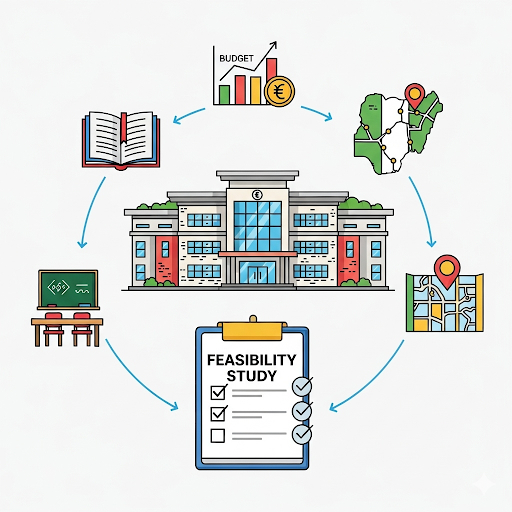
The process of conducting a feasibility study for schools in Nigeria follows systematic steps that build upon each other to create comprehensive analysis. The first phase involves market research and demographic analysis to understand your target community’s educational needs, preferences, and spending capacity. This research forms the foundation for all subsequent analysis and recommendations.
Site selection and location analysis constitute the second critical phase of your feasibility study. We examine factors like accessibility, safety, infrastructure availability, and growth potential. Many schools fail because founders select locations based on affordability rather than strategic considerations. Professional site analysis considers how location affects enrollment potential, operational costs, and long-term sustainability.
Financial modeling and business plan development complete the feasibility study process. This phase translates market research findings into detailed financial projections, operational plans, and implementation timelines. The resulting business plan serves as your roadmap for securing funding, obtaining regulatory approvals, and launching operations according to proven success principles.
Market Trends Shaping Education Entrepreneurship in Nigeria Today
Current market trends are reshaping education entrepreneurship in Nigeria in ways that create both opportunities and challenges for new entrants. The trend toward international curriculum adoption continues accelerating, especially in urban markets where parents seek globally competitive educational options for their children. British, American, and International Baccalaureate programs command premium fees while requiring significant investments in teacher training and materials.
Technology integration has become a competitive necessity rather than an optional enhancement in Nigerian schools. Parents increasingly expect schools to provide computer literacy, internet access, and digital learning tools. The COVID-19 pandemic accelerated adoption of online learning platforms and blended education models. Schools that successfully integrate technology while maintaining personal interaction gain significant competitive advantages in enrollment and retention.
Environmental sustainability and social responsibility have emerged as important factors in parent school selection decisions. Modern Nigerian parents prefer schools that teach environmental awareness, community service, and ethical leadership alongside traditional academic subjects. This trend creates opportunities for schools that position themselves as character-building institutions that prepare students for responsible citizenship and global leadership roles.
Financing Models Backed by Education Feasibility Studies in Nigeria
Professional education feasibility studies in Nigeria significantly improve access to funding by providing investors and lenders with credible analysis and projections. Banks and private investors require detailed feasibility documentation before approving education sector loans or investments. Well-prepared feasibility studies demonstrate market viability, financial sustainability, and risk management that financial institutions need for approval decisions.
Equity financing becomes more accessible when supported by comprehensive feasibility analysis. Angel investors and venture capital firms actively seek education opportunities in Nigeria but require professional-grade documentation to evaluate investment potential. Feasibility studies provide the market analysis, competitive positioning, and financial projections that sophisticated investors use to make funding decisions and structure investment terms.
Alternative financing models like community partnerships and parent prepayment programs work best when backed by credible feasibility research. These innovative funding approaches require detailed market analysis to structure sustainable arrangements that benefit all parties. Professional feasibility studies provide the analytical foundation for developing creative financing solutions that reduce startup capital requirements while ensuring long-term viability.
Challenges in Education Entrepreneurship in Nigeria and How to Overcome Them
Education entrepreneurship in Nigeria faces several persistent challenges that require strategic planning and professional guidance to overcome successfully. Regulatory complexity ranks among the most significant obstacles as requirements vary across federal, state, and local government levels. Many entrepreneurs underestimate the time and effort required to secure all necessary approvals, licenses, and permits for legal school operations.
Teacher recruitment and retention present ongoing challenges in Nigeria’s competitive education market. Quality educators, especially those trained in international curricula or specialized subjects, are in high demand and short supply. This scarcity drives up salary costs and creates operational risks when key teachers leave unexpectedly. Successful schools develop comprehensive human resource strategies that include competitive compensation, professional development opportunities, and positive work environments.
Infrastructure limitations including unreliable electricity, poor internet connectivity, and inadequate transportation networks affect school operations throughout Nigeria. These challenges require creative solutions and contingency planning to ensure consistent educational delivery. Schools that invest in backup power systems, alternative internet connections, and transportation services gain competitive advantages while ensuring operational continuity during infrastructure disruptions.
How Novatia Consulting Supports Feasibility Study for Schools Nigeria
Novatia Consulting provides comprehensive support throughout the feasibility study for schools Nigeria process, from initial market research through implementation guidance and ongoing advisory services. Our multidisciplinary team includes education specialists, market researchers, financial analysts, and regulatory experts who collaborate to deliver actionable insights and recommendations tailored to your specific project requirements.
Our market research methodology combines quantitative and qualitative approaches to provide accurate, reliable data for decision-making. We conduct parent surveys, demographic analysis, competitor assessments, and regulatory reviews using proven research techniques. This comprehensive approach ensures your feasibility study reflects actual market conditions rather than assumptions or outdated information that could lead to poor investment decisions.
Implementation support extends beyond feasibility analysis to include business plan development, regulatory guidance, and operational planning assistance. We help clients navigate complex approval processes, design optimal organizational structures, and develop realistic launch timelines. Our ongoing advisory relationships support clients through the critical early operational phases when challenges inevitably emerge and expert guidance proves invaluable.
Education Feasibility Study in Nigeria: Case Studies and Best Practices
Real-world case studies demonstrate how professional education feasibility studies in Nigeria contribute to successful school launches and sustainable operations. Greensprings School’s expansion into multiple Nigerian markets began with detailed feasibility analysis that guided location selection, curriculum decisions, and operational planning. This systematic approach enabled rapid growth while maintaining educational quality and financial performance.
Chrisland Schools’ success across different Nigerian markets illustrates how feasibility studies inform market-specific strategies. Each new location required separate analysis to understand local demographics, competition, and preferences. This location-specific approach helped them adapt their educational model to diverse markets while maintaining brand consistency and operational standards that parents recognize and trust.
International School Lagos represents best practices in feasibility-driven premium positioning. Their initial feasibility study identified market demand for truly international education that could compete with overseas boarding schools. This positioning required significant investment in facilities, faculty, and programs but enabled premium pricing that justified the costs and generated strong returns for investors.
Why Feasibility Studies Define the Success of Private Schools in Nigeria
Feasibility studies define success in Nigeria’s private school sector by providing the analytical foundation for sound strategic decisions. Schools launched without proper feasibility analysis often fail because founders make assumptions about market demand, competition, or operational requirements that prove incorrect. Professional feasibility studies replace assumptions with data-driven insights that guide every major decision.
Market positioning represents one of the most critical decisions facing private school founders, and feasibility studies provide the analytical framework for optimal positioning choices. Should you target budget-conscious families or affluent parents seeking premium education? Will you focus on Nigerian curriculum enhancement or international program delivery? These positioning decisions affect every aspect of your school from location to staffing to marketing strategies.
Operational planning benefits tremendously from feasibility study insights about infrastructure requirements, regulatory compliance, and staffing needs. Many school founders underestimate the complexity of education operations and face costly surprises during startup phases. Comprehensive feasibility studies identify these operational requirements early, allowing proper planning and budgeting that prevents disruptions and ensures smooth launches.
Education Entrepreneurship in Nigeria: Opportunities in EdTech and Innovation
Education entrepreneurship in Nigeria increasingly focuses on technology-enabled innovation that addresses traditional education challenges while creating scalable business opportunities. Digital learning platforms can reach students in remote areas where physical schools are impractical. Online tutoring services provide personalized instruction that supplements classroom learning. Educational software and apps create new revenue streams while improving learning outcomes.
The Nigerian EdTech market offers significant opportunities for entrepreneurs who understand local needs and constraints. Limited internet bandwidth requires lightweight applications that function effectively on mobile devices. Power supply challenges necessitate offline capabilities and cloud-based content storage. Cultural preferences favor personalized instruction and teacher-student relationships that pure technology solutions cannot replace.
Blended learning models that combine digital tools with traditional instruction show particular promise in Nigerian markets. These approaches allow schools to improve educational outcomes while managing costs effectively. Students benefit from personalized digital content while maintaining human interaction that Nigerian parents value. Entrepreneurs who master this balance can build scalable education businesses that serve diverse market segments profitably.
Policy and Regulatory Framework for Education Feasibility Study in Nigeria
Nigeria’s policy and regulatory framework for education continues evolving in ways that affect feasibility study considerations and investment decisions. Recent policy changes support private sector participation in education delivery while maintaining quality standards and public oversight. Understanding these regulatory trends helps entrepreneurs position their ventures for long-term success rather than short-term compliance.
The National Policy on Education provides the overarching framework for all educational activities in Nigeria, including private school operations. State-level education laws and regulations add specific requirements that vary significantly across Nigeria’s 36 states. Local government authorities impose additional requirements related to building permits, environmental compliance, and operational licenses that affect feasibility analysis and implementation planning.
International curriculum recognition and accreditation requirements present complex challenges for schools seeking to offer globally recognized programs. Professional feasibility studies examine these requirements and assess compliance costs and timelines. Many entrepreneurs underestimate the complexity and expense of maintaining international accreditations, making this analysis critical for realistic financial projections and operational planning.
The Road Ahead: Building Sustainable Education Businesses in Nigeria
The path forward for education entrepreneurship in Nigeria requires balancing innovation with sustainability, growth ambitions with market realities, and international standards with local preferences. Successful entrepreneurs will be those who invest in comprehensive planning, including professional feasibility studies, before launching their ventures. This foundation enables sustainable growth and long-term success in Nigeria’s competitive education market.
Sustainability in education entrepreneurship extends beyond financial considerations to include social impact, environmental responsibility, and contribution to Nigeria’s human capital development. Schools that position themselves as partners in national development while delivering quality education create stronger market positions and more sustainable business models. This alignment with national priorities also improves access to government support and policy favorable treatment.
Building sustainable education businesses requires ongoing commitment to quality improvement, market adaptation, and stakeholder satisfaction. The most successful education entrepreneurs treat feasibility studies as the beginning of continuous market analysis rather than one-time planning exercises. This commitment to data-driven decision making and strategic adaptation enables long-term success in Nigeria’s dynamic education sector.
Frequently Asked Questions
What is an education feasibility study and why do I need one in Nigeria? An education feasibility study is a comprehensive analysis that evaluates the viability of starting an education business in Nigeria. It examines market demand, financial requirements, regulatory compliance, and operational challenges to determine if your education concept can succeed profitably in the Nigerian market.
How much does an education feasibility study cost in Nigeria? Professional education feasibility studies in Nigeria typically cost between ₦3-10 million depending on scope, location, and complexity. This investment helps prevent costly mistakes and significantly improves your chances of securing funding and achieving long-term profitability in the education sector.
How long does it take to complete an education feasibility study in Nigeria? A comprehensive education feasibility study usually takes 10-16 weeks to complete in Nigeria. This timeline includes market research, financial analysis, regulatory review, competitor assessment, and detailed report preparation. Complex projects or multiple locations may require additional time for thorough analysis.
What are the key components of an education feasibility study in Nigeria? Essential components include market analysis, demographic research, competitive assessment, financial projections, regulatory compliance review, location evaluation, infrastructure planning, staffing requirements, and comprehensive risk analysis. Each component provides critical insights for strategic decision-making and investment planning.
Can I start an education business in Nigeria without a feasibility study? While legally possible, starting an education business without a feasibility study significantly increases your risk of failure. Most successful education entrepreneurs and investors require thorough feasibility analysis before committing capital to education projects in Nigeria’s competitive market.
How do I choose the right consultant for my education feasibility study in Nigeria? Select consultants with proven education sector experience in Nigeria, strong local market knowledge, and successful project track records. Review their previous education projects, client testimonials, methodology, and team qualifications to ensure alignment with your specific needs and objectives.
What regulatory approvals do I need for education entrepreneurship in Nigeria? Required approvals include business registration with Corporate Affairs Commission, education licenses from relevant state authorities, local government permits, fire safety certificates, health department approvals, and environmental compliance certifications. Requirements vary by location and education type.
How much capital do I need to start an education business in Nigeria? Capital requirements vary significantly based on education type, location, and scale. Basic learning centers may require ₦5-15 million, while comprehensive schools need ₦50-500 million or more. Your feasibility study will provide detailed capital projections based on your specific concept.
What are the biggest challenges in education entrepreneurship in Nigeria? Major challenges include regulatory complexity, teacher recruitment difficulties, infrastructure limitations, intense competition, funding constraints, and cultural adaptation requirements. Professional feasibility studies help identify and develop strategies to overcome these challenges effectively.
How can technology improve education entrepreneurship opportunities in Nigeria? Technology enables scalable learning platforms, personalized instruction, remote education delivery, and operational efficiency improvements. EdTech solutions can reach underserved markets, reduce operational costs, and create new revenue streams while improving educational outcomes for Nigerian students.